

On 18 November 2026, the Washington-based Pew Research Center released its long-awaited projections on the future of world religions. The headline finding: Muslims are expected to outnumber Christians by 2035.1
Predictably, the reactions came from two directions. Christian “missionaries” and their allies on the “ex-Muslim” circuit rushed to explain it away. Islam only grows because Muslims have more babies, they say, while Muslims themselves are supposedly leaving the faith by the millions. At the same time, some well-meaning Muslims shared the headline as proof that the world is embracing Islam en masse.
Both camps would do well to actually read the report, along with the independent data that sit beside it. Taken together, census returns, academic surveys and even the missionaries’ own head-counts tell a story about conversion that is far more damaging to the missionary narrative than any headline about 2035.
What Pew Actually Measured
It should be mentioned right from the onset that Pew does not use the word “conversion”. It uses “religious switching”: the difference between the religion a person was raised in and the religion they identify with today. Pew deliberately avoids the word “conversion” because so many of these changes are to having no religion at all.2
Only movement between broad categories is counted, such as Buddhist to Christian. A Protestant who becomes a Catholic does not count. The estimates are drawn from surveys in 112 countries and territories conducted between 2008 and 2024. For the remaining 89 countries, which lack switching data, Pew simply assumes that no switching occurs.3 Bear this in mind; we shall return to it.
This is survey data, gathered from people themselves, which puts it in a different class from the emotional testimonies that fill missionary paperbacks. Even so, Pew’s figures are best read alongside other evidence, and that is what we shall do.
The Great Exodus, But Not From Islam
For years, we have been told that Muslims are abandoning Islam in droves. Entire ministries have been built on the testimonies of self-styled “former Muslims”. So who, according to the data, is actually leaving?
Between 2020 and 2070, about 211 million people are projected to leave the religion they grew up in and become religiously unaffiliated. Only about 94 million unaffiliated people are projected to join a religion. The net winner is the “nones”, with a gain of 117 million.4
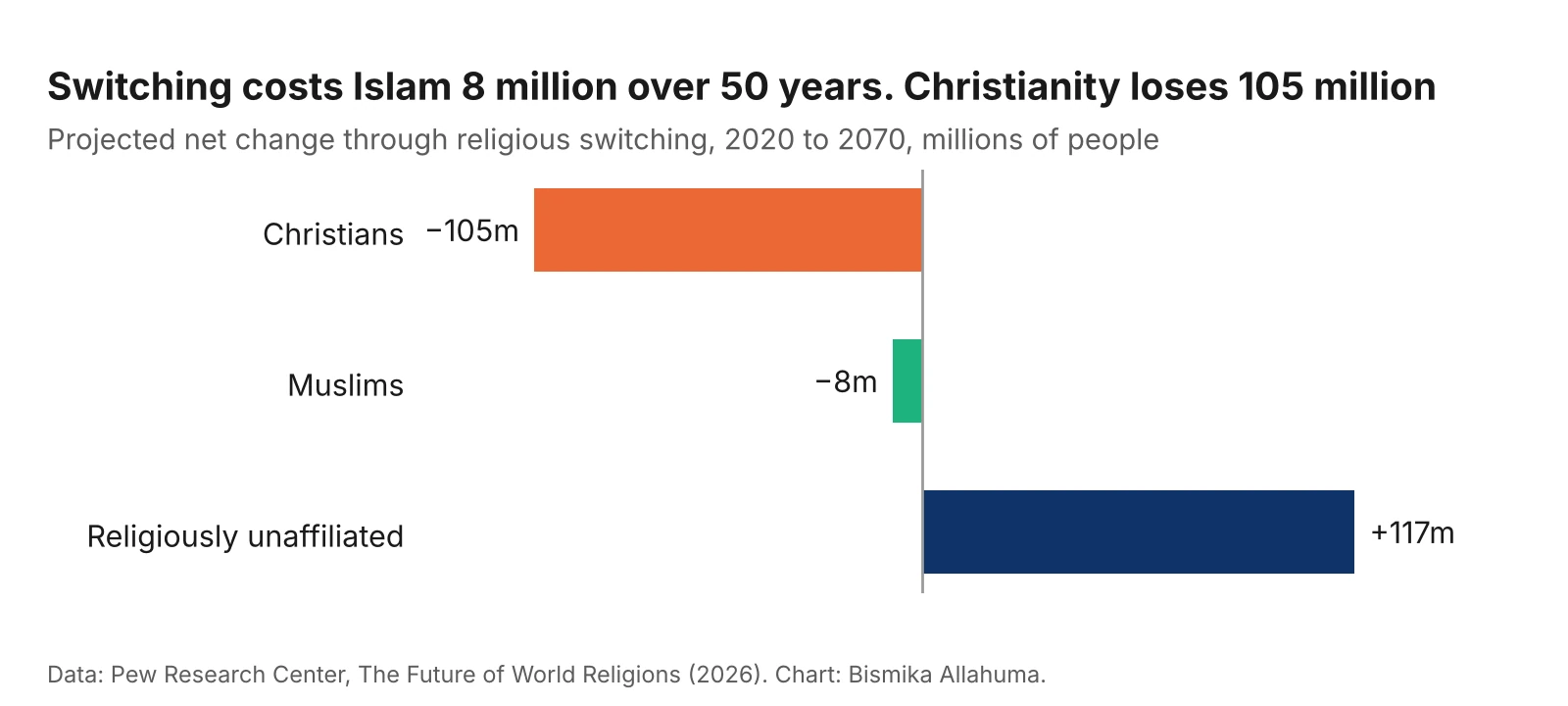
Christianity bears the brunt of this. Pew projects a net loss of 105 million Christians through switching between 2020 and 2070. In the period 2020–2025 alone, for every one person who joins Christianity, 2.3 are projected to leave.5 Almost all of those who leave end up with no religion at all.6
And Muslims? Pew puts the global retention rate of Muslims at 99%, the highest of any religious group, shared only with Hindus.7 Over fifty years, switching is projected to cost Islam a net 8 million people, against 105 million for Christianity.8 Set against a Muslim population projected to exceed 3.6 billion by 2070,9 that is roughly 0.2%. To call that an exodus is absurd; it is a rounding error.
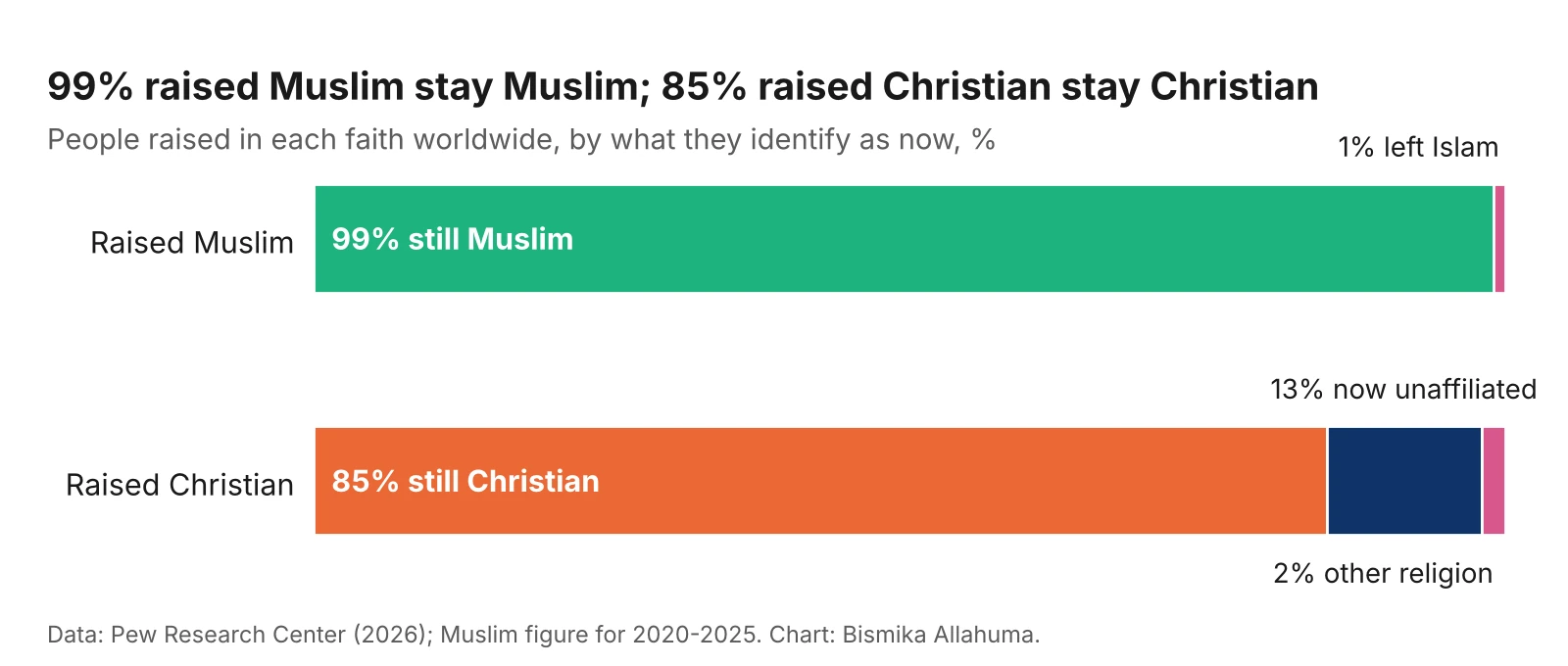
Honesty requires us to add that retention is lower in the West: 93% in Europe and 85% in North America.10 Yet even where Muslim retention is at its weakest, the community does not shrink, because Islam gains about as many converts as it loses. The United States shows this clearly:11
| United States (2017 survey) | Muslims | Christians |
|---|---|---|
| Raised in the faith, no longer identify with it | 24% | 22% |
| Current adherents who are converts | 23% | 6% |
What the Independent Data Say
The missionary will reply that Pew is just one organisation. Very well. Let us look elsewhere.
The Arab world: the “wave” that receded
In 2019, Arab Barometer, in a survey commissioned for BBC News Arabic, found that the share of respondents calling themselves “not religious” had risen from 8% in 2012–13 to 13%, and to 18% among those under 30. The coverage ran under the headline “Arabs are losing their religion”.12 Critics of Islam circulated it endlessly.
Far fewer reported what came next. In the 2021–2022 wave, citizens across the region became less likely to call themselves “not religious”, with the largest change among the young. Arab Barometer’s own Michael Robbins concluded that the earlier trend “has reversed in the 2020s”.13 Youth aged 18–29 led the return to religion.14 A peer-reviewed study in Religions (2025) agrees: the figures partly returned to pre-2013 levels, describing a passing “wave” rather than a consistent trend.15
It must also be noted that “not religious” in these surveys measures self-rated piety. Leaving Islam is another question entirely.
Britain: the strongest transmission of any faith
A peer-reviewed study by Cardiff University sociologists, published in Sociology in 2012, used Home Office Citizenship Survey data on nearly 14,000 adults and 1,278 young people. It found “a higher transmission of Islam than any of the other religious categories” in England and Wales.16 A major review in the Annual Review of Sociology found that community support, coethnic concentration and marriage within the faith help Muslims in Europe maintain religious commitment, though the picture is more complicated for the second generation.17
Stephen Bullivant’s 2018 report on Europe’s young adults, based on the European Social Survey, found that 70% of UK 16–29-year-olds reported no religion. Around seven-eighths of the young “nonverts” were former Christians. The rest were raised in other religions, and in the UK sample none of them had been raised Muslim.18
Censuses: where the Christians are going
National censuses tell the same story.19
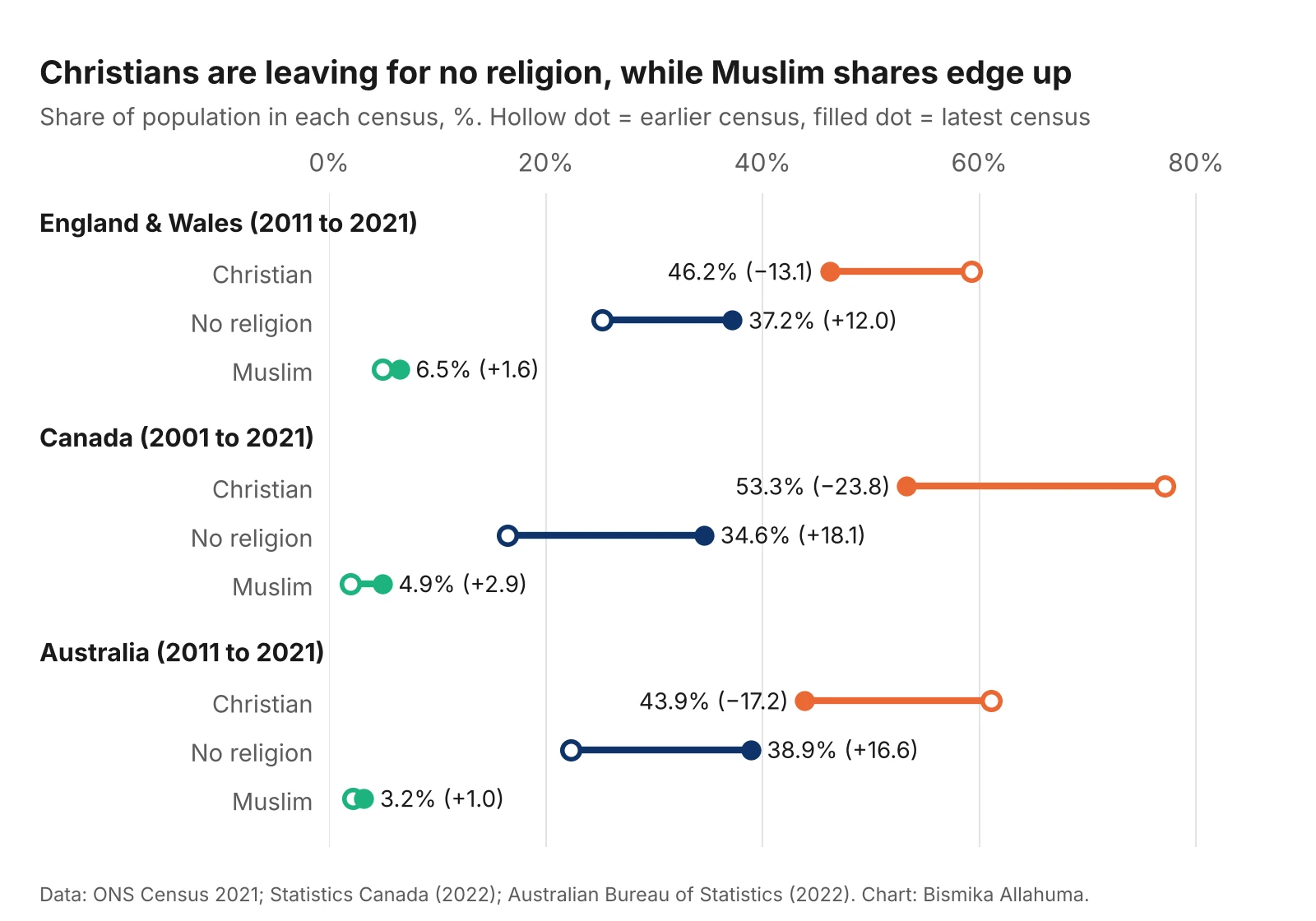
A census measures identity at one moment, not switching, and Muslim growth in these countries owes much to immigration and a younger age profile. But the direction of travel is unmistakable. In England and Wales, the number of Christians fell by about 5.8 million in a decade, while “no religion” grew by about 8.1 million.20 Those leaving the churches are walking out of religion altogether.
The “Six Million a Year” Myth
No discussion of the “exodus” narrative is complete without its favourite statistic: that six million Muslims convert to Christianity every year. It is repeated on countless missionary websites, usually attributed to a “leading Saudi cleric” on Al Jazeera.
The source is Sheikh Ahmad al-Qataani, speaking on Al Jazeera in 2000. He was speaking of Africa, and he used the figure to urge Muslims to support his own da’wah work there. He offered no evidence for it.21 Missionary retellings have since stretched it to the entire Muslim world and garbled both the date and his nationality.
The arithmetic alone sinks it. Six million a year since 2000 would mean more than 150 million converts by now. Yet the most generous academic estimate, by Duane Alexander Miller and Patrick Johnstone, researchers sympathetic to Christian mission, counted nearly 10 million believers from a Muslim background worldwide in 2010, with a range of roughly 5 to 16 million.22 That total was accumulated over fifty years, from 1960 onwards, and amounted to about 0.6% of the world’s Muslims at the time.
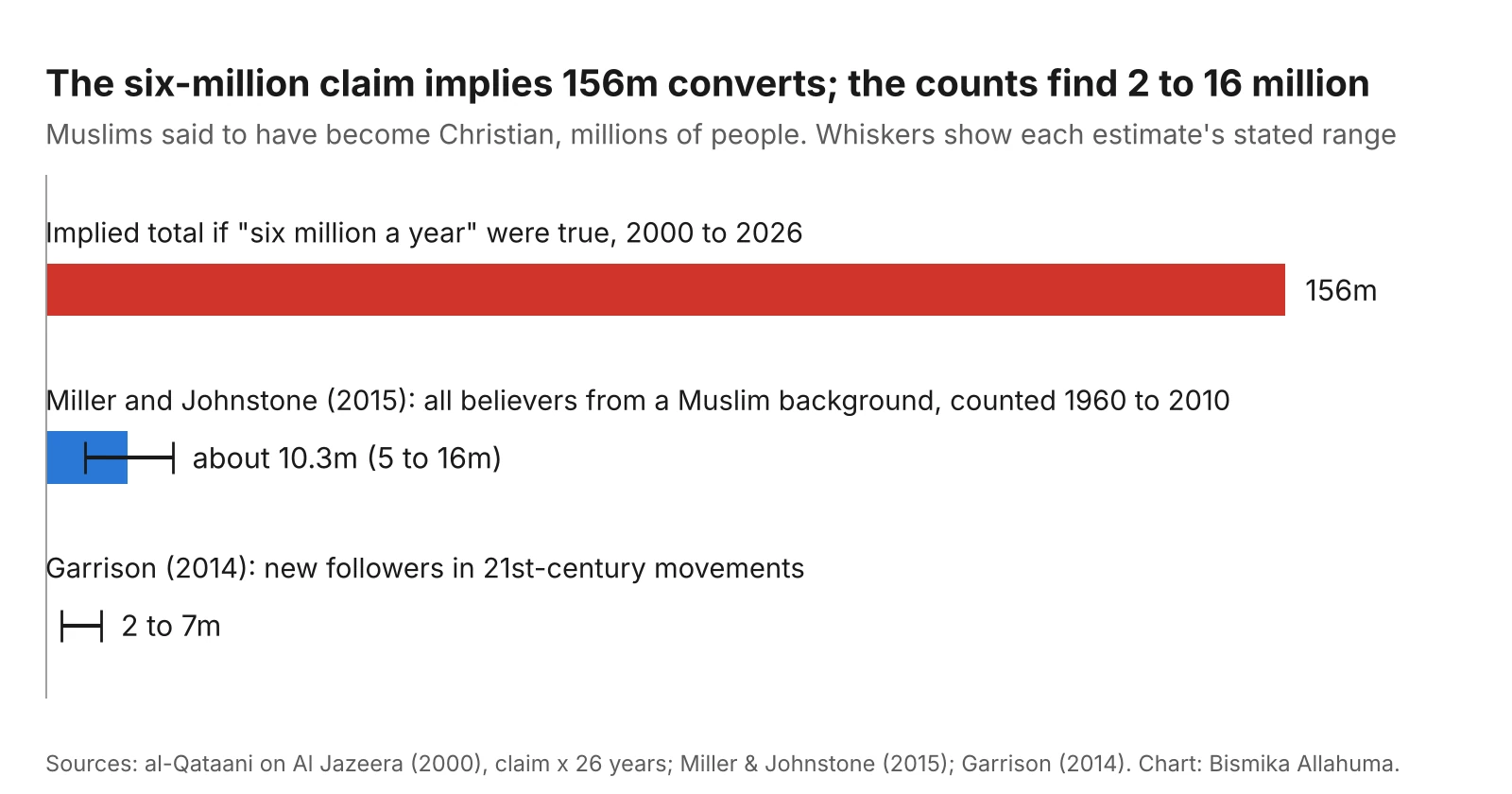
The authors themselves warn of “a natural tendency to inflate numbers” for fund-raising, and note reports of converts being baptised several times over.23 A large part of their total comes from Indonesia, in the aftermath of the 1965 coup, when the state required every citizen to register with one of the official religions.24
David Garrison’s A Wind in the House of Islam (2014), another favourite of the missionaries, puts the number of new followers at between 2 and 7 million. His threshold for a “movement” is just 1,000 baptisms or 100 new churches over two decades, and his figures come from interviews arranged through missionary networks, not random sampling. Garrison himself concedes this may be a statistically small drop in the vast sea of Islam.25
Iran: The Exception That Proves the Rule
The strongest card the missionaries hold is Iran. A 2020 online survey by GAMAAN, with about 50,000 respondents, found only 32.2% identifying as Shi’ite Muslim, 22.2% as having no religion, 8.8% as atheist and 1.5% as Christian.26 Mission organisations promptly extrapolated to around a million Iranian Christians.
GAMAAN itself acknowledges that its survey was more likely to reach people who share its organisers’ views, and that respondents selected themselves. It is an online, non-probability sample of literate internet users. The direction it shows may well be real; the magnitudes are uncertain.
But look at what the data actually show. The shift is overwhelmingly towards no religion and national identity, and it is happening under a state that enforces religion by law. That is precisely what the Qur’an warns against: “Let there be no compulsion in religion.”27 Faith imposed by the state produces only nominal belief.
“Spread by the Sword”? The Numbers Say Otherwise
The other old charge is that Islam spreads by coercion, by pressure or by aggressive proselytising. If that were true, the switching figures would show Islam making large net gains from other faiths.
They show nothing of the sort. Between 2020 and 2070, about 9 million Christians are projected to become Muslim, and about 9.2 million Muslims to become Christian.28 The flows are almost exactly even. In the words of Pew’s senior demographer Conrad Hackett, “Islam’s projected growth is not due to people who convert from Christianity.”29
| Switching between Islam and Christianity, 2020–2070 | People (projected) |
|---|---|
| Christians becoming Muslim | 9.0 million |
| Muslims becoming Christian | 9.2 million |
| Net balance for Islam | −0.2 million |
Conversion to Islam in the West is real, but modest. Kevin Brice of Swansea University estimated about 100,000 converts in the UK in 2010, with roughly 5,200 new converts a year, and found “no evidence of a mass conversion”.30
In fairness, the same data cut the other way too. Muslims who share the 2035 headline as proof of a worldwide wave of reverts are not reading the report either. Islam’s rise is driven by births. Our case for Islam has never needed exaggeration, and it does not need it now.
Switching Changes the Margin, Not the Outcome
Pew tested the effect of switching directly. In a scenario with no religious switching after 2020, which the authors themselves call implausible and use only to isolate its effect, Christians would make up 31% of the world in 2070, compared with about 29% in the main projection. The unaffiliated would be 15%, 1.6 points lower.31
Even then, Muslims would still overtake Christians.32 Switching affects the size of the gap, but the crossover happens regardless. Where it truly bites is in the historically Christian West:33
| Region (2070) | Christians, main projection | Christians, no switching | Unaffiliated, main projection | Unaffiliated, no switching |
|---|---|---|---|---|
| North America | 46% | 57% | 41% | 31% |
| Europe | 52% | 60% | 33% | 25% |
| Latin America–Caribbean | 77% | 85% | 19% | 12% |
So Why Is Islam Growing?
If not conversion, then what? The answer is demography.
| Driver, 2020–2025 | Muslims | Comparison group |
|---|---|---|
| Children per woman | 3.1 | 2.5 (Christians)34 |
| Median age | 24 | 33 (non-Muslims)35 |
| Babies born | 252 million (to Muslim mothers) | 208 million (to Christian mothers)36 |
Replacement level is about 2.1 children per woman.37 Pew projects that Muslim births will outnumber Muslim deaths by at least 1.6 billion between 2020 and 2070.38
None of this is new. The political scientist Eric Kaufmann argued years ago, in Shall the Religious Inherit the Earth? (2010), that higher fertility among religious populations would reshape the world.39 The 2035 milestone comes from Muslim families.
The Limits of the Data
We would be doing exactly what we accuse the missionaries of if we pretended these figures were beyond question. They are not.
Pew’s 99% global retention rate rests partly on assumption: in the 89 countries without switching data, roughly 12% of the world’s adults in 2020 and including Saudi Arabia, Pew assumes no switching at all.40 In countries where leaving Islam carries legal or social penalties, surveys may well under-count those who have left. And all projections assume that recent trends will continue, which they may not.41
These are real limits, and they call for caution about exact figures. Still, every source examined here, the missionaries’ own head-counts included, points the same way: there is no mass exodus from Islam.
The Real Lesson: Retention
The real problem facing the missionaries is that Christianity cannot keep its own children. When 2.3 people are projected to walk out for every one who walks in, and North America’s Christian share is projected to fall to 46% by 2070, the crisis lies within the churches themselves.42
For Muslims, however, this is no reason for complacency. Retention among Muslims in North America already stands at 85%.43 The same forces that emptied the churches of the West (urbanisation, the internet and generational change) are already reaching Muslim societies. Each generation has to be shown why Islam is true. That is precisely why the work of answering anti-Islam polemics remains necessary.
The headline says Islam will be the largest religion in the world by 2035. The deeper finding is that those leaving Christianity are abandoning religion altogether, while Muslims, by the grace of Allah, are holding on to their faith.
And Allah knows best.
- Pew Research Center, The Future of World Religions: Population Growth Projections, 2020–2070, 18 November 2026. doi:10.58094/qx43-nn81. https://www.pewresearch.org/religion/2026/11/18/the-future-of-world-religions-population-growth-projections-2020-2070/ ↩︎
- Pew Research Center, “Key Factors Shaping the Global Future of Religions”, 18 November 2026. https://www.pewresearch.org/religion/2026/11/18/key-factors-shaping-the-global-future-of-religions/ ↩︎
- Pew Research Center, “Methodology: Future of World Religions”, 18 November 2026. https://www.pewresearch.org/religion/2026/11/18/methodology-future-of-world-religions/ ↩︎
- Pew Research Center, “Key Factors Shaping the Global Future of Religions”. ↩︎
- Ibid. ↩︎
- Pew Research Center, “The Future of the Global Christian Population”, 18 November 2026. https://www.pewresearch.org/religion/2026/11/18/the-future-of-the-global-christian-population/ ↩︎
- Pew Research Center, “Key Factors Shaping the Global Future of Religions”. ↩︎
- Conrad Hackett, “Islam Will Soon Be the World’s Largest Religion, but Christianity Will Keep Growing Too”, Pew Research Center, 18 November 2026. https://www.pewresearch.org/short-reads/2026/11/18/islam-will-soon-be-the-worlds-largest-religion-but-christianity-will-keep-growing-too/ ↩︎
- Pew Research Center, The Future of World Religions. ↩︎
- Pew Research Center, “The Future of the Global Muslim Population”, 18 November 2026. https://www.pewresearch.org/religion/2026/11/18/the-future-of-the-global-muslim-population-2/ ↩︎
- Besheer Mohamed and Elizabeth Podrebarac Sciupac, “The Share of Americans Who Leave Islam Is Offset by Those Who Become Muslim”, Pew Research Center, 26 January 2018. ↩︎
- Arab Barometer, “Arabs Are Losing Their Religion in Backlash Against Islamists”, 25 June 2019. https://www.arabbarometer.org/media-news/arabs-are-losing-their-religion-in-backlash-against-islamists/ ↩︎
- Michael Robbins, “MENA Youth Lead Return to Religion”, Arab Barometer, 23 March 2023. https://www.arabbarometer.org/2023/03/mena-youth-lead-return-to-religion/ ↩︎
- Arab Barometer, “A New Dawn for Political Islam?”, May 2023. https://www.arabbarometer.org/2023/05/a-new-dawn-for-political-islam/ ↩︎
- “A Wave of Unbelief? Conservative Muslims and the Challenge of Ilḥād in the Post-2013 Arab World”, Religions 16, no. 6 (2025): 670. https://www.mdpi.com/2077-1444/16/6/670 ↩︎
- Jonathan Scourfield, Chris Taylor, Graham Moore and Sophie Gilliat-Ray, “The Intergenerational Transmission of Islam in England and Wales: Evidence from the Citizenship Survey”, Sociology 46, no. 1 (2012): 91–108. doi:10.1177/0038038511419189. https://orca.cardiff.ac.uk/id/eprint/30799/ ↩︎
- David Voas and Fenella Fleischmann, “Islam Moves West: Religious Change in the First and Second Generations”, Annual Review of Sociology 38 (2012): 525–545. doi:10.1146/annurev-soc-071811-145455. ↩︎
- Stephen Bullivant, Europe’s Young Adults and Religion: Findings from the European Social Survey (2014–16) (London: St Mary’s University, March 2018). ↩︎
- Office for National Statistics, “Religion, England and Wales: Census 2021”, 29 November 2022, https://www.ons.gov.uk/peoplepopulationandcommunity/culturalidentity/religion/bulletins/religionenglandandwales/census2021; Statistics Canada, The Daily, 26 October 2022, https://www150.statcan.gc.ca/n1/en/daily-quotidien/221026/dq221026b-eng.pdf; Australian Bureau of Statistics, “Religious Affiliation in Australia”, 2022, https://www.abs.gov.au/articles/religious-affiliation-australia. ↩︎
- Ibid. ↩︎
- Duane Alexander Miller and Patrick Johnstone, “Believers in Christ from a Muslim Background: A Global Census”, Interdisciplinary Journal of Research on Religion 11, article 10 (2015). https://www.religjournal.com/pdf/ijrr11010.pdf ↩︎
- Ibid. ↩︎
- Ibid. ↩︎
- Ibid. ↩︎
- David Garrison, A Wind in the House of Islam (Monument, CO: WIGTake Resources, 2014). ↩︎
- Ammar Maleki and Pooyan Tamimi Arab, “Iranians’ Attitudes Toward Religion: A 2020 Survey Report” (GAMAAN, 2020). https://gamaan.org/wp-content/uploads/2020/09/GAMAAN-Iran-Religion-Survey-2020-English.pdf ↩︎
- Qur’an, 2:256. Translation: A. Yusuf Ali, The Holy Qur’an: Text, Translation and Commentary (1934–1937), as published by Tanzil (en.yusufali). ↩︎
- Hackett, “Islam Will Soon Be the World’s Largest Religion”. ↩︎
- Ibid. ↩︎
- Kevin Brice, A Minority Within a Minority: A Report on Converts to Islam in the United Kingdom (London: Faith Matters, 2011). ↩︎
- Pew Research Center, “Key Factors Shaping the Global Future of Religions”. ↩︎
- Ibid. ↩︎
- Ibid. ↩︎
- Pew Research Center, The Future of World Religions. ↩︎
- Pew Research Center, “The Future of the Global Muslim Population”. ↩︎
- Ibid. ↩︎
- Pew Research Center, The Future of World Religions. ↩︎
- Pew Research Center, “Key Factors Shaping the Global Future of Religions”. ↩︎
- Eric Kaufmann, Shall the Religious Inherit the Earth? Demography and Politics in the Twenty-First Century (London: Profile Books, 2010). ↩︎
- Pew Research Center, “Methodology: Future of World Religions”. ↩︎
- Ibid. ↩︎
- Pew Research Center, “Key Factors Shaping the Global Future of Religions”. ↩︎
- Pew Research Center, “The Future of the Global Muslim Population”. ↩︎




Leave a Reply