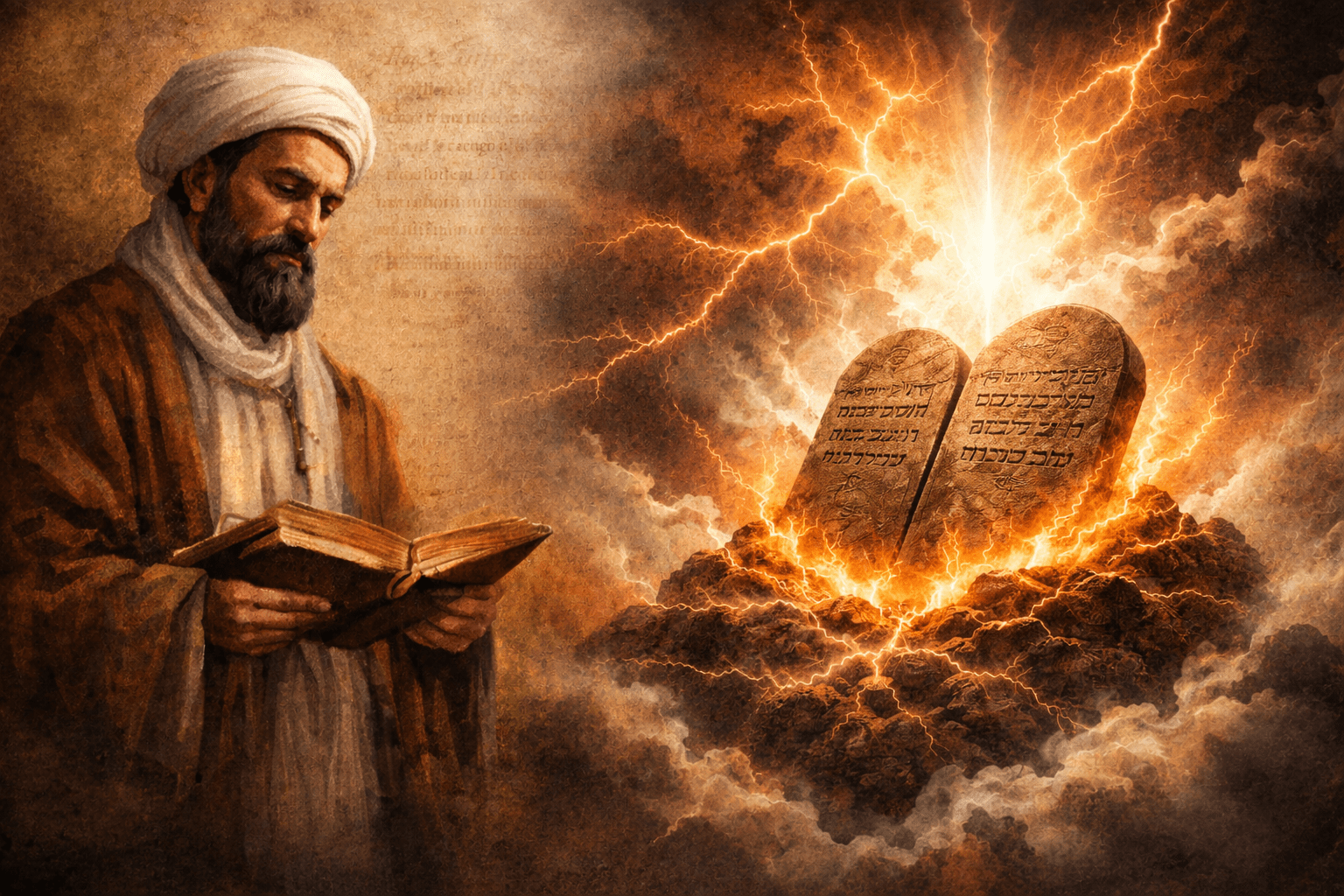
Ibn Ḥazm (994 CE – 1064 CE) was a Muslim scholar of great repute from Cordoba, during the Muslim Spain era. He is widely regarded as the “Father of Comparative Religion”. In his celebrated magnum opus entitled Kitab al-Fasl fi al- Milal wa al-Ahwa’ wa al-Nihal, he predated modern Biblical textual criticism by several centuries and as Krentz admits, Ibn Ḥazm’s criticisms generally represented the first, albeit rudimentary, systematic historic criticism of the Bible.1 He had demonstrated his prowess in Biblical textual criticism by giving many examples of internal contradictions in the Bible.
The following biblical contradiction is taken from the book Muslim Understanding of Other Religions: A Study of Ibn Ḥazm’s Kitab al-Faṣl fī al-Milal wa al-Ahwāʾ wa al-Niḥal, and, inshāʾ Allāh, it will form part of an ongoing series reproducing Ibn Ḥazm’s criticisms of the Bible and Christianity, together with further elaborations on our part to refine his arguments and strengthen the case against the Bible.2
Does God change His mind? According to Ibn Ḥazm, Exodus 32:10–14 and 33:3–14 ascribe al-badāʾ (change of mind) to God, and this presents a problem for the nature of God and His attributes, particularly His all-knowingness. In Ibn Ḥazm’s usage, al-badāʾ does not mean ignorance, but the appearance of a new determination after a prior one has already been declared.
We quote Exodus 32:10-14 as follows:
“…now therefore let me alone, that my wrath may burn hot against them and I may consume them; but of you I will make a great nation.” But Moses besought the LORD his God, and said, “O LORD, why does thy wrath burn hot against thy people, whom thou hast brought forth out of the land of Egypt with great power and with a mighty hand? Why should the Egyptians say, ‘With evil intent did he bring them forth, to slay them in the mountains, and to consume them from the face of the earth’? Turn from thy fierce wrath, and repent of this evil against thy people. Remember Abraham, Isaac, and Israel, thy servants, to whom thou didst swear by thine own self, and didst say to them, ‘I will multiply your descendants as the stars of heaven, and all this land that I have promised I will give to your descendants, and they shall inherit it for ever.'” And the LORD repented of the evil which he thought to do to his people.
Yet in another passage, it seems that there was a different agreement. The following passage is from Exodus 33:3-14:
“And I will send an angel before you, and I will drive out the Canaanites, the Amorites, the Hittites, the Per’izzites, the Hivites, and the Jeb’usites. Go up to a land flowing with milk and honey; but I will not go up among you, lest I consume you in the way, for you are a stiff-necked people.” When the people heard these evil tidings, they mourned; and no man put on his ornaments.
For the LORD had said to Moses, “Say to the people of Israel, ‘You are a stiff-necked people; if for a single moment I should go up among you, I would consume you. So now put off your ornaments from you, that I may know what to do with you.'” Therefore the people of Israel stripped themselves of their ornaments, from Mount Horeb onward.
Now Moses used to take the tent and pitch it outside the camp, far off from the camp; and he called it the tent of meeting. And every one who sought the LORD would go out to the tent of meeting, which was outside the camp. Whenever Moses went out to the tent, all the people rose up, and every man stood at his tent door, and looked after Moses, until he had gone into the tent. When Moses entered the tent, the pillar of cloud would descend and stand at the door of the tent, and the LORD would speak with Moses. And when all the people saw the pillar of cloud standing at the door of the tent, all the people would rise up and worship, every man at his tent door.
Thus the LORD used to speak to Moses face to face, as a man speaks to his friend. When Moses turned again into the camp, his servant Joshua the son of Nun, a young man, did not depart from the tent. Moses said to the LORD, “See, thou sayest to me, ‘Bring up this people’; but thou hast not let me know whom thou wilt send with me. Yet thou hast said, ‘I know you by name, and you have also found favor in my sight.’ Now therefore, I pray thee, if I have found favor in thy sight, show me now thy ways, that I may know thee and find favor in thy sight. Consider too that this nation is thy people.” And he said, “My presence will go with you, and I will give you rest.”
When one compares the above passages side by side, the internal contradictions between especially Exodus 32:10, 32:14 and 33:2-3 on the one hand and Exodus 33:14 on the other, clearly raises many problems of theological and moral concern from the Biblical context. In this case that was quoted above, in spite of God’s determination to punish the Israelites for their idolatrous conduct, He did not execute punishment due to the intercession of Moses who had “reminded” God of His promise made with Abraham and the patriarchs for their descendants. This Biblical passage seems to implicitly suggest that this “reminder” had made God realise his “wrong” decision and have Him repenting for it. Such an obvious “error” or even to imply such a thing is hardly befitting any person of integrity, let alone God, the Almighty.3
It is sometimes argued that the threat of destruction in Exodus 32:10 should be understood as merely conditional, since Moses was told to “leave” God alone, implying that intercession could avert the outcome. Yet this does not remove the underlying difficulty. The narrative still portrays God as announcing one course of action, receiving an argument from Moses, and then declaring a different one. The text does not merely describe the unfolding of a fixed decree, but depicts Moses’ reminder of the patriarchal covenant as the decisive factor that produces a new divine determination.
This is reinforced in Exodus 33:5, where God says, “that I may know what to do with you,” language that expresses deliberation rather than the execution of a settled plan.4 This language does not describe the execution of a settled decree, but the suspension of one while a decision is being weighed.
Likewise, Exodus 33:3 and 33:14 place side by side a withdrawal of divine presence and its subsequent restoration. Whether framed as conditional or not, the text presents God as revising an expressed intention in response to human intervention, which is precisely the instability Ibn Ḥazm identified. A conditional warning still presupposes a fixed outcome in the absence of intervention; Exodus, however, depicts the intervention itself as generating a different divine outcome.
Hence, the implications of Exodus 33:2-14 compared to other Biblical passages on the characteristics of God as discussed by Ibn Hazm are manifold:
(1) God is portrayed as revising an announced intention in response to human argument;
(2) God is portrayed as issuing statements that are not narratively stable.
With the problems that are evident in Exodus 33:2-14, one must either agree to the above accusations against God or admit that this is an internal contradiction, which do not agree with passages concerning God and His characteristics in other parts of the Bible. Most certainly, in this case, Ibn Ḥazm’s criticism of the Bible with regard to God contradicting Himself is thus not without basis and here, the Bible contradicts itself internally.
Conclusions
The juxtaposition of Exodus 32 and 33 provides a clear example of the internal tensions that Ibn Ḥazm identified in the Hebrew Bible. His argument does not rest on philosophical speculation alone, but on direct comparison of biblical passages that present incompatible descriptions of God’s will. For Ibn Ḥazm, this is strong evidence that the biblical text, as it stands, cannot be fully reconciled with a coherent doctrine of divine perfection.
The issue is not whether God is merciful, but whether the text depicts divine determination as narratively reversible. These internal tensions confirm Ibn Ḥazm’s judgment that the Hebrew Bible contains biblical contradictions that cannot be reconciled with a coherent doctrine of divine perfection.
And only God knows best! 

- Edgar Krentz, The Historical Critical Method (Fortress Press, 1975), p. 41[⤶]
- See Ghulam Haider Aasi, Muslim Understanding Of Other Religions: A Study of Ibn Hazm’s Kitab al-Fasl fi al-Milal wa al-Ahwa’ wa al-Nihal (Adam Publishers, 2004), pp. 92-114 for a summary of Ibn Ḥazm’s major criticisms of the Pentateuch.[⤶]
- Ibn Hazm Kitab al-Fasl, pt. 1, pp. 163-164; Ghulam Haider Aasi, ibid., p. 105[⤶]
- Exodus 33:5 in Hebrew reads: וְאֵדְעָה מָה אֶעֱשֶׂה־לָּךְ (veʾedʿāh māh ʾeʿĕśeh-lāk), literally “so that I may know what I will do with you.” The verb וְאֵדְעָה (“that I may know”) expresses pending determination rather than the execution of a settled decision.[⤶]