
“ExHindu” (in response to an explanation regarding the Black Stone) wrote[dead link]:
- Give any explanation you want. I dont buy it. Arabs have been kissing that rock long before Mo[sic]. I call that IDOL Worshipping. You can label me as Islamophobe and I am proud that you give me that label. In the same manner, I anoint you a Hinduphobe.
I find it rather ironic to see someone who uses the moniker “ExHindu” accusing yours truly of being a “Hinduphobe”. After all, what does the use of the Internet username “ExHindu” really signify ? A case of the pot calling the kettle black, we cannot really say.
Nevertheless, I believe that it is time that a response to this rather annoying polemic about the nature of the Black Stone (al-Hajar al-Aswad) and its significance in Islam by those who have an axe to grind about Islam (or otherwise known tenderly as the “Islamophobics”) is finally needed.
We will look at the common allegations about the Black Stone and then seek to address the matters concerned, insha’Allah.
[toc]
Physical Description of the Black Stone (al-Hajar al-Aswad)
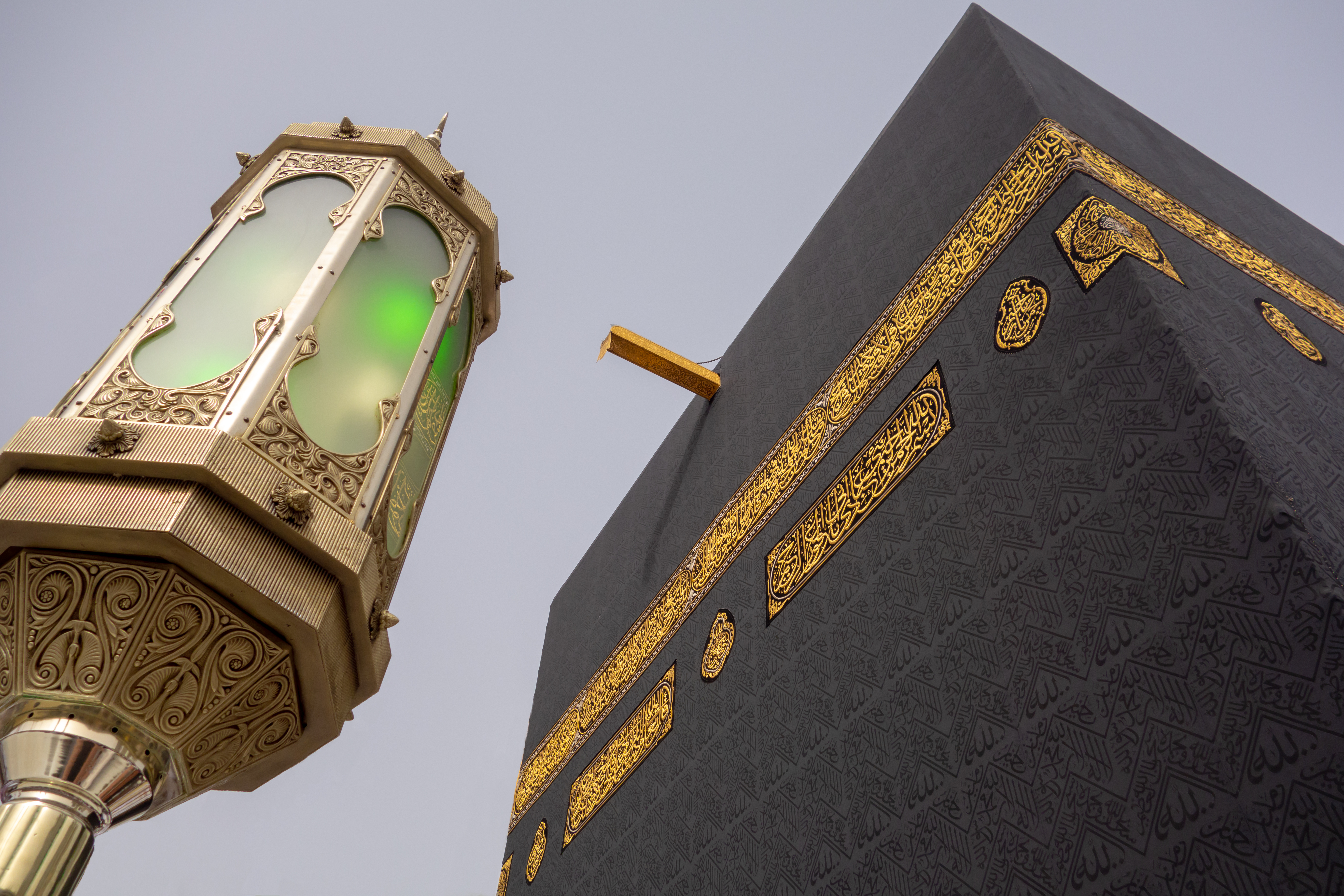
First, we shall describe the physical nature of the Stone itself. The Black Stone (Ar : ٱلْحَجَرُ ٱلْأَسْوَد, al-Hajar al-Aswad) is built into the Kaaba wall, at the eastern corner of the Kaaba, about 5 ft. above the ground level, not very far from the door of the Kaaba. The Kaaba itself can itself be described as a black box, which Muslims face in daily prayers.
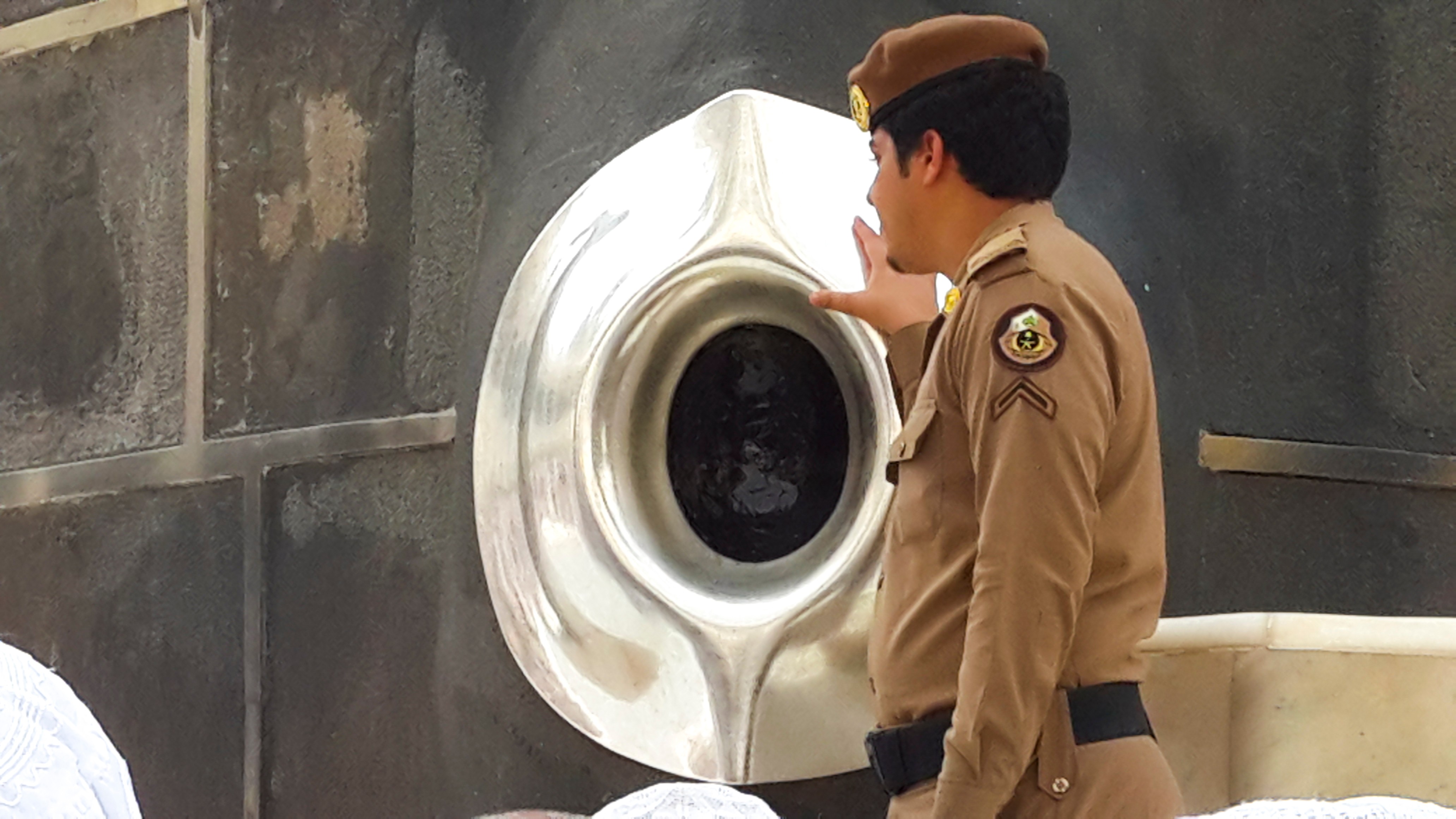
Muslims believe that the Black Stone was originally given to Abraham, who built the Kaaba used the Black Stone as a corner stone for the structure. Abraham and Ishmael taught the early Makkan Arabs monotheism ; after the passing of Abraham and Ishmael, the Makkan Arabs with time regressed into pagan practices including idol worship. They ended up having a pantheon of gods, despite the original message of Abraham and Ishmael which taught the early Arabs to worship God alone (monotheism).
Going back to the Black Stone, it was originally a single piece of rock but todayconsists of three large pieces and several small fragments (in which it was formerly broken) stuck together and surrounded by a large ring of stone, which in turn is held together by a silver band.
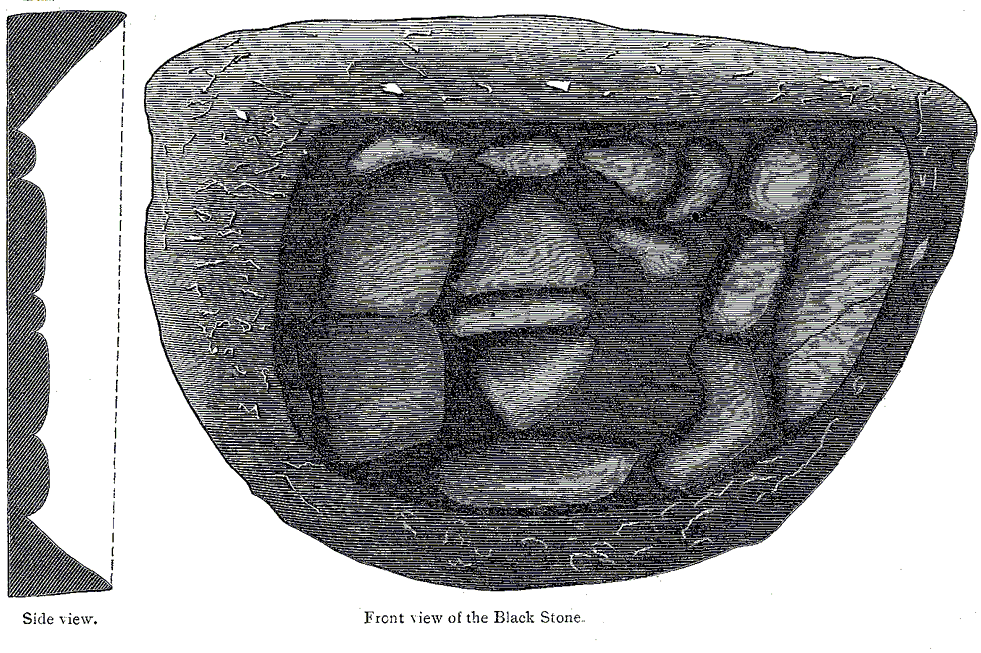
Swiss traveller Johann Ludwig Burckhardt visited Mecca in 1814, and provided a detailed description as follows :
It is an irregular oval, about seven inches [18 cm] in diameter, with an undulated surface, composed of about a dozen smaller stones of different sizes and shapes, well joined together with a small quantity of cement, and perfectly well smoothed ; it looks as if the whole had been broken into as many pieces by a violent blow, and then united again. It is very difficult to determine accurately the quality of this stone which has been worn to its present surface by the millions of touches and kisses it has received. It appeared to me like a lava, containing several small extraneous particles of a whitish and of a yellow substance. Its colour is now a deep reddish brown approaching to black. It is surrounded on all sides by a border composed of a substance which I took to be a close cement of pitch and gravel of a similar, but not quite the same, brownish colour. This border serves to support its detached pieces ; it is two or three inches in breadth, and rises a little above the surface of the stone. Both the border and the stone itself are encircled by a silver band, broader below than above, and on the two sides, with a considerable swelling below, as if a part of the stone were hidden under it. The lower part of the border is studded with silver nails.
Burckhardt, Johann Ludwig (1829). Travels in Arabia, Comprehending an Account of Those Territories in Hedjaz which the Mohammedans Regard as Sacred. Henry Colburn, New Burlington Street. p. 250
It was narrated that Ibn ‘Abbaas said : The Messenger of Allah (peace and blessings of Allah be upon him) said : “The Black Stone came down from Paradise.“
Material of the Black Stone
The material of the Black Stone has not been precisely determined. It is sometimes classified as lava and sometimes as basalt. The reason for this difficulty is that its visible surface is worn smooth by hand-touching, etc.
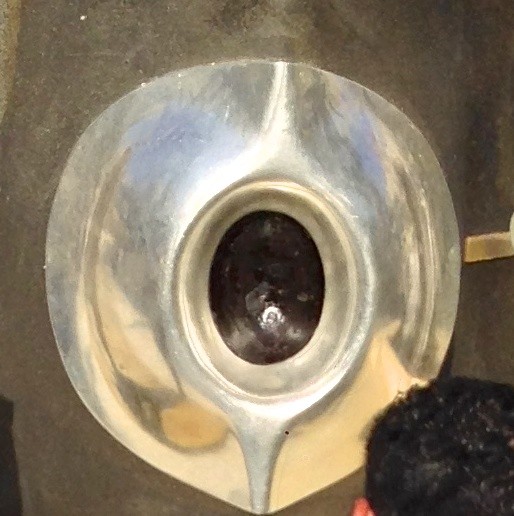
Some Islamophobes have begun a baseless attack on the appearance of the Black Stone by alleging that it looks like a vagina in order to insult Muslims. The silver frame around the Black Stone were for centuries maintained by the Ottoman Sultans in their role as Custodian of the Two Holy Mosques. This silver frame is a modern addition and the structure look doughnut shaped as a result. The frames wore out over time due to the constant handling by pilgrims and were periodically replaced.
It is reported that when the Prophet Muhammad(P) entered the city of Makkah as a victorious leader, there were 360 idols around the Kaaba
Thus saying that “Muslims worship the Black Stone as an idol” is clearly the most absurd thing ever pronounced in the history of mankind.
Significance of the Black Stone
From a physical perspective, therefore, the Black Stone does not have any special significance or importance.
Umar(R), later to become the second Caliph of Islam, is reported to have said that he fully realized that the Black Stone was merely a stone and thus had no power of its own to harm or benefit anyone
As for the reasons as to why we have the Black Stone in the wall of the Kaaba, we read about the following reasons, that :
- (a) it symbolizes the starting-point during the circumambulation of the Ka’abah, thus facilitating the remembrance of the number of circumambulations.
(b) at this point, the Muslims, who are close to the Kaaba (during their circumambulation) touch the stone, while those who are away from it, raise their hands towards it, symbolizing the renewal of their pledge of allegiance with the Lord of the Kaaba. In this symbolic expression, the Black Stone is taken as a symbol of an oath on the hand of God.
And with this, it is clear that this baseless assertion of Islamophobes is refuted. And only God knows best ! 


we kiss the stone because the prophet did. and the prophet is the perfect example for muslims and god commanded the muslims to follow and obey the prophet. we trust the prophet. the black stone is believed to be originating from heaven, so, out of respect for the stone and trust in the prophet, we kiss it.
if muslims had worshiped the stone, umar wouldn’t have said that the stone is just a stone and couldn’t benefit nor harm us. this is because it is considered blasphemy when saying tis about something you worship.
we pray towards mecca because god commanded us to. sure, mecca had been holy since before muhammad because the first person who built it was abraham.
is it wrong to do things the prophet did if god says he’s the perfect example for muslims ?
and i like Emilia’s example of the bread and jesus’s body. i believe it’s called eucharist ? eating the eucharist doesn’t mean they’re worshiping it.
the hajar-ul-aswad is just a piece of stone. it doesn’t have the power to benefit or harm people. God has all those power, but not the stone. :D
I must admit that one aspect of the Islamic religion which amuses me is that Mecca is the holy city … but it was holy long before Mohammed was born. The (now) Islamic temple, the Kaaba, was the main spiritual object of the polytheistic Arabs who predated Mohammed. Yes, he had his little ceremonial destruction of the idols around the Kaaba in order to signify the destruction of polytheism and the triumph of monotheism, but recall that Mohammed had at first tried to make Jerusalem the city to bow down to and pray towards (really, such rigidly ritualistic behavior is akin to idolatry — the ritual (as the idol) becomes of greater actual (if not nominal) importance than the intangible “spirtual feeling” of religion), but since people had for countless previous generations been making pilgrimages to the Kabaa, Mohammed simply submitted to popular pressure and announced one day that the object of spiritual veneration was henceforth to be, big surprise, Mecca and the Kaaba temple. I believe ExHindu was trying to point out that many Muslims ACT in a manner consistent with treating the Kaaba as an idol, whatever they profess. Of course, since one of their mantras is that “there is but one God,” they don’t think of themselves as acting in such a manner, but the human mind has been rife with contradiction since the first man walked the earth.
Undoubtedly such a man of contradiction was Mohammed himself, since he showed the utmost ingratitude to the Jews who were kind enough to allow him to lodge in Medina … but then, I’m giving him the benefit of the doubt by calling him contradictory, otherwise I’d simply call him a materialistic opportunist. So, I really shouldn’t be surprised to see contradictoriness in his followers.
I’m not trying to be argumentative but the question wasn’t answered. We know that Muhammed was not a polytheist, we know that some Muslims, such as the wabbists make very strong and rational arguments against the belief of saints and the like. So why pay any attention to a black stone that cannot speak for those who kissed/touched it.
It also doesn’t explain why this stone ought to be venerated at all — which it seems to be (again not trying to be argumentative). It holds much more significance than a counter. A further question question — my ignorance — why pray towards Mecca when god is everywhere ?
Hi. I’m a muslim, although i’m not very spiritual in that sense. Prophet Muhammad kissed the stone. Hence why Umar kissed the stone as well and in time, followed by Muslims. My two cents would be this ; if you feel that by kissing the stone you are idolising the stone, then please do not kiss the stone. Prophet Muhammad could kiss the stone and not idolise it at the same time because his faith is strong. We are only human and our faith could be weak and we could be swayed.
Although i do think that Muslims should stop the habit of kissing the stone. What was a simple gesture has turned into an overzealous habit that could deem, and sometimes is, one form of idolising and it is HARAM in Islam.
To non-Muslims, please understand that the stone was once kissed by Prophet Muhammad, and to us Muslims, it is sacred. Same reason as why the Christians eat the bread that symbolises the body of Christ, and same reason why Hindus believes the mouse is Ganesha’s avatar.
It’s not logic (how could an elephant ride a tiny mouse, how could a bread signify the body of Christ, and how could a stone be of such significant).
They are just symbolism.
If you don’t worship the stone why do you kiss it ? Did muhammed kiss the stone ? If he did, then isn’t this ritual done out of emulation and thus idolising muhammed ?
I don’t want to offend anyone but it seems as if the seperation of god and muhammed in Islam supports an unquestioned pacifism to do anything and everything for god, but when really, in truth, it is immitation of muhammads actions and rituals.
I’m not an islamaphobe or whatever but I think that there are cracks in Islam. I also feel that if you want to stop having to call people islamaphobes more should be done to educate the uneducated. NOT for the purpose of converting the world, but to further gods interests by uniting all different faiths by way of wanting, sincerely, to get to know each other. I think that islam limits this. by way of labelling whoever opposes islam or see’s something not entirely right as an infedel or enemy. Any comments or reply would be well received.
You post does not explain why Muslims still follow an old Arabian ritual of kissing the stone. Indeed, if Omar himself couldn’t tell, I don’t think you can. It’s just a polytheistic habit carried over to Islam, just like most of the Hajj rituals.
Kissing someone or something does NOT mean that you worship it or show submission to it. As you have said, it is mainly out of love.
Muslims also kiss the Quran or the hands of old Shaykhs or relics that are known to be from the Prophet peace be upon him.
Why do you missionaries ALWAYS go around misrepresenting such simple things acts into something much more sinister. Your distortions of Islam only show how much your hatred of it affects your sensibilities !
Hi, I love my wife, I hugn kiss her to show my affection for her. I hug and kiss my children because I love them. Malays have a custom to kiss the hand of their parent in respect. The subjects of Sultans kisses his mejesty’s hand in submitsiveness/homage to their king. So what is the significant of kissing the black stone mean ? Show of affection to the black store ? Show of love for the stone ? Show of respect for the black stone ? Show of submission to the black stone ?
[Admin — Kissing your wife and children does not mean that you WORSHIP them or take them as gods.]