
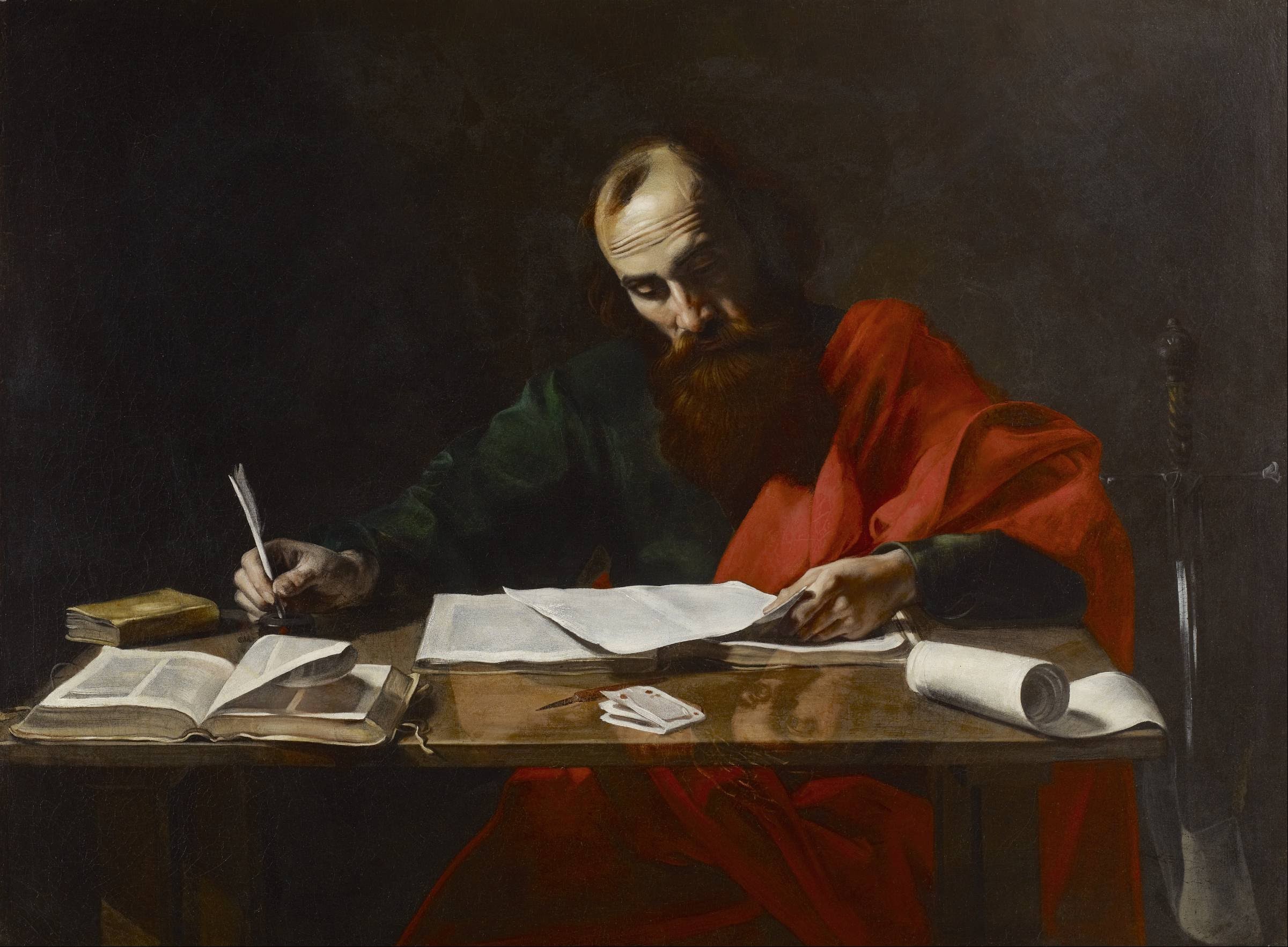
The purpose of this brief article is to show that Paul, the self-acclaimed “apostle” whom the Christians follow, has no place in Islam at all. Muslims believe that between the time periods of the Prophet Jesus(P) and the Prophet Muhammad(P), no Messenger of God had come between them, whether to the Gentiles or the Jews. This is based on an agreed hadith recorded by Imam Muslim and Imam Bukhari, as follows :
Volume 4, Book 55, Number 651 :
Narrated Abu Huraira : I heard Allah’s Apostle saying, “I am the nearest of all the people to the son of Mary, and all the prophets are paternal brothers, and there has been no prophet between me and him (i.e. Jesus).”
We know of only one man who claimed to be a messenger of God in this intervening period. That man was called Paul, formerly known as Saul, of Tarsus.
[toc]
Self-Proclaimed Apostle of Jesus
According to the Christians, Paul of Tarsus was an “apostle of Jesus”. Jesus(P) had allegedly appeared to him in a “vision” as God and chose him as his “apostle”. Hence, Paul is also a “messenger” of God because Jesus(P) is believed to be God. It is said that Paul was sent “to the Gentiles” to preach to them the Gospel, i.e. he “has been entrusted with the task of preaching” with a message (Galatians 2:7 – 10).
Since Paul claimed that he was sent by Jesus(P) to the nations with a particular message, it, therefore, follows that he is a “messenger”, and hence he uses the title “apostle” for himself.
Quotes from the New Testament where the title “apostle” is applied to him are as follows :
- “Paul, a servant of Christ Jesus, called to be an apostle and set apart for the gospel of God…” (Romans 1:1)
- “Paul, called to be an apostle of Christ Jesus by the will of God…” (1 Cor. 1:1)
- “Paul, an apostle — sent not from men nor by man, but by Jesus Christ and God, the Father…”
(Galatians 1:1)
Thus we see that based on the earlier hadith cited from Bukhari and Muslim, Islam clearly denies the so-called “apostleship” of Paul and dispute his claim that he was ever an “apostle of God”, as he lived between the time periods of Jesus(P) and Muhammad(P).
However, the missionary Sam Shamoun took exception to this and proceeded to state otherwise in his article.
Missionary Confusion Between Historical Records and the Theological
One of the claims that the missionary Shamoun made is that Paul was apparently “recognised” as a true follower of Jesus(P), simply because he was mentioned in Muslim records of the Sirah. According to the missionary :
-
Contemporary Muslims […] may deny the apostleship of Paul, but the first Muslims did not as the following citations conclusively prove
He then proceeds to quote citations from sources which are merely the record of historians, and they were not even from Muslim theologians regarding the position of Paul in Islam. Even then, some of his quotes are at best spurious and deceptive. Consider the citation which the missionary has provided to us from the translation of Ibn Ishaq’s Sirat Rasul Allah :
Those whom Jesus son of Mary sent, both disciples and those who came after them, in the land were : Peter the disciple and Paul with him, (Paul belonged to the followers and was not a disciple) to Rome. Andrew and Matthew to the land of the cannibals ; Thomas to the land of Babel, which is in the land of the east ; Philip to Carthage and Africa ; John to Ephesus the city of the young men of the cave ; James to Jerusalem which is Aelia the city of the sanctuary ; Bartholomew to Arabia which is the land of Hijaz ; Simon to the land of Berbers ; Judah who was not one of the disciples was put in place of Judas.
A. Guillaume (trans.), The Life of Muhammad : A Translation of Ibn Ishaq’s Sirat Rasul Allah, p. 653
Compare the above description of the disciples of Jesus(P) with the accounts in Acts and you would find the relevant parallels. Apart from the fact that Ibn Ishaq clearly wrote that Paul was not a disciple of Jesus(P), the footnote to this passage also says :
The form of the names shows that the source was Greek. It probably came to I. I. through Syriac.
Ibid.
So what does this tell us ? It shows that Ibn Ishaq had merely recorded this as a statement of history based on a secondary source from the account in Acts which was either the Greek or the Syriac, and not from an Islamic viewpoint. This we can see as stated in the Introduction of the same work, that :
Occasionally, he [Ibn Ishaq] inserted verses in his narrative, and sometimes gives his own opinion.
ibid., Introduction, p. xv
Thus we see the deception that this missionary has no doubt instilled in his twisting of Ibn Ishaq’s work. The rest of his citations from Muslim historians, we repeat, also affirm that Paul was merely a follower of Peter, and not a disciple of Jesus(P).
Conclusion : Paul In Islam
So what do the early Muslim theologians say about Paul in Islam ? The reality is that the early Muslims theologians recognised that Paul was a hypocrite and the corrupter of the religion we know today as “Christianity”.
We hence would like to sum up the position of Paul in Islam with the words of the eminent Shaykhul-Islaam Ibn Taymiyyah (d. 728H), that :
This is just like what Paul fabricated when he entered into the Religion of Christianity in order to corrupt the Religion of the Christians.
This statement was originally stated by al-Laalikaaiee (no. 2832) from ash-Shaibee. It was authenticated by Shaykhul-Islaam Ibn Taymiyyah in Minhaajus-Sunnah (1÷29) and he pointed out the earlier scholars who did this. It was declared hasan by al-Haafidh Ibn Hajar in Fath al-Bari(12÷270).
Ash-Shahratain (d. 1153), a theologian of the Asharite school, echoes the above words of Ibn Taymiyyah by stating that :
Paul, however, disordered his affair, made himself (Peter’s) partner, altered the basis of his knowledge, and mixed it with the argument of the philosophers and the (evil) suggestion of his heart.
As quoted by William Montgomery Watt, Muslim-Christian Encounters : Perceptions and Misconceptions (Routledge, 1991), p. 69
And only God knows best ! 


Let me address this heresy, first Islam and Mohammed were not even born when Paul help spread the gospel of Jesus through all of Asia and parts of Europe, so Islam has no right to comment about something that took place 500 years before it. Every scientific and historical record all agree Jesus died on the cross even people that are not Christians
Secondly : Muslims fool themselves by saying the believe in Jesus, if you dont believe Jesus is the son of God, came on earth to die on the cross for the sins of mankind and after 3 days resurrected then you DONT believe in Jesus.
Thirdly, Can anyone tell me places where Paul has contradicted the teachings of Jesus.
Jusuf is saying that Christians hate the truth. We follow Jesus who told us : “ i am the truth, the way and the life, “ Truth is the basis of christian life. I will not insult you with what is thought of islam.
Christians hate the truth.
While I personally can’t imagine written Midrashim existing in the first century it is obvious to most people who have spent any time investigating, that Paul was a false apostle.
Sorry Christians, it’s just true. Ask the Ebionites.
Whatever any Hadith or Qoran verse says , is not our problem. Nearly everything is distorted and made a mockery of when it comes to our beliefs. Your religion did not exist and your prophet has only repeated heresies which were rampant . In order to stop the heresies, the council of Nicea was called to be . Therefore everything different to that council is still a heresy . The prophet preferred the heresie appparently , not only those of christ but also Jewish heresies.
Paul was a fervant, radical anti Christ who was on his way to Damascus to go and fight the christians. When he was on the road to Damascus, he heard a voice saying “Why are you persecuting me?” The rest you can read in the Gospel. He came to love and believe in Christ and that has made him an apostle. Not to be compared with the apostles (12) who were with Christ before the crucifixion. His Spiritual Conversion made an apostle out of him. The Cruxifiction, Resurrection and weeks later the pouring out of the SPIRIT was the end of the most beautiful story ever told. There was nothing to be added and now we are waiting for HIS second coming. When the whole world will have heard or read about His Word , then the period of His coming will be near. This is what Jesus himself said.
Not only that, but Peter wrote directly about Paul in his own second epistle :
MEV :
2Pe 3:14 Therefore, beloved, since you are waiting for these things, be diligent that you may be found by Him in peace, spotless and blameless.
2Pe 3:15 Keep in mind that the patience of our Lord means salvation, even as our beloved brother Paul has also written to you according to the wisdom given to him.
2Pe 3:16 As in all his letters, he writes concerning these matters, in which some things are hard to understand, which the unlearned and unstable distort, as they also do the other Scriptures, to their own destruction.
2Pe 3:17 You therefore, beloved, since you know these things beforehand, beware lest you also fall from your own firm footing, being led away by the deception of the wicked.
The ESV renders the last verse even more potently for those who deny Paul :
2Pe 3:17 You therefore, beloved, knowing this beforehand, take care that you are not carried away with the error of lawless people and lose your own stability.
“Error of lawless people” is pretty much saying that individuals who deny that Paul was Christ’s messenger, are breaking the law of God and are deceivers thusly. (Whether they are conscious of that or not, is another matter.)
Therefore, those are some pretty strong words from Peter for anyone who wishes to take a shot at Paul.
From personal experience, I find that people who have huge issues with Paul, they have demonic or worldly religious programming in their mind, or they have an ongoing demonic attack, to grind them down. Satan and his fallen angels always attack in order to split apart that point where humans are at their weakest, dividing an individual or a group of people into weaker, smaller and more easily controllable parts. If an individual already believes there is some kind of major conflict between Jesus’ teaching and Paul’s teaching, Satan will attack you there. And the result will be either : that you will yield to Satan (because it is in your selfish interest to disbelieve both in Jesus being the only way to God and/or to disbelieve and distrust Paul), or you will call on Jesus to protect you, purify you and to show you the truth. Fulfilling His commandment that a person who asks, shall receive.
Satan loves to drive distrust, fear and confusion into the very heart and mind of every man and woman. He NEEDS humans to be at each other’s throats constantly. That takes the focus off their learning/maturing, they become sinful in condemning, hating and killing each other. It also takes the focus of him, so that humans forget that he is the real enemy, that he is the one who has created so many false religions in the world to divide the people up, and lead them to death. Once the focus is off him, humans conflict with each other and Satan is free to implement his rule over this world ever more.
What do you say about the witness in the book of acts where Paul is clearly accepted by the other apostles as one with a legitimate claim and apostolic mission ?
Because Paul’s name does not appear in Hebrews, and he said he signed every epistle with his own name (2 Thessalonians 3:17), it is safe to say that Hebrews was written by someone else. Also, the style of writing is completely different. In Hebrews the author almost never refers to himself, whereas in Paul’s epistles, he almost never stops boasting.
Paul did not meet any of the qualifications for being an apostle. These included being a witness of Jesus’s baptism, his ministry, and his resurrection from the dead (Acts 1:21 – 22). In fact only two people met these qualifications : Matthius and Barnabus. Paul was nowhere around at the time, and his epistles show that he seemed to know very little about Jesus except that he was crucified.
I used to believe Paul, but no more. He taught too much that was in opposition to Jesus. As you say of so many who follow Paul, “…seeing they see not, and hearing they hear not, neither do they understand.” (Matthew 13:13) Yes indeed !
Paul’s Innovation
“For this Melchisedec, king of Salem, priest of the most high God… Without father, without mother, without descent, having neither beginning of days, nor end of life…” (Hebrews 7:1,3)
Here is a candidate for Divinity itself, for only God Almighty could possess these qualities. Adam had a beginning (in the garden), Jesus had a beginning (in the stable); Adam had an end and, claim the Christians, so had Jesus “and he gave up the ghost”. But where is Melchisedec ? Perhaps he is hibernating somewhere like Rip Van Winkel (a fairy tale character who slept for many ages.)
And what is this “Hebrews”? It is the name of one of the Books of the Holy Bible, authored by the gallant St. Paul, the self appointed thirteenth apostle of Christ. Jesus had twelve apostles, but one of them (Judas) had the Devil in him. So the vacancy had to be filled, because of the “twelve” thrones in heaven which had to be occupied by his disciples to judge the children of Israel (Luke 22:30).
Saul was a renegade Jew, and the Christians changed his name to “Paul”, probably because “Saul” sounds Jewish. This St. Paul made such a fine mess of the teachings of Jesus, peace blessings be upon him, that he earned for himself the second most coveted position of “The Most Influential Men of History” in the monumental work of Michael H. Hart : The 100 or The Top Hundred or the Greatest Hundred in History. Paul outclasses even Jesus because, according to Michael Hart, Paul was the real founder of present day Christianity. The honor of creating Christianity had to be shared between Paul and Jesus, and Paul won because he wrote more Books of the Bible than any other single author, whereas Jesus did not write a single word.
Paul needed no inspiration to write his hyperboles here and in the rest of his Epistles. Did not Hitler’s Minister of Propaganda Goebbels say : “The bigger the lie the more likely it is to be believed’? But the amazing thing about this exaggeration is that no Christian seems to have read it. Every learned man to whom I have shown this verse to, seemed to be seeing it for the first time. They appear dumbfounded, as described by the fitting words of Jesus :
“…seeing they see not, and hearing they hear not, neither do they understand.” (Matthew 13:13)
The Holy Quran also contains a verse which fittingly describes this well cultivated sickness :
“Deaf, dumb and blind, will they not return (to the path).” (2:18)